5 minutes
When AI Models Start Talking to Each Other
Originally published on Substack, Oct 27, 2025
For a while now, I’ve been using LLMs in a way that feels a bit like hosting a party for AIs. What happens when you don’t just prompt a single model but let multiple models talk to each other? To explore that question, and being inspired by the holiday, I built two demos that make the idea both technical and fun:
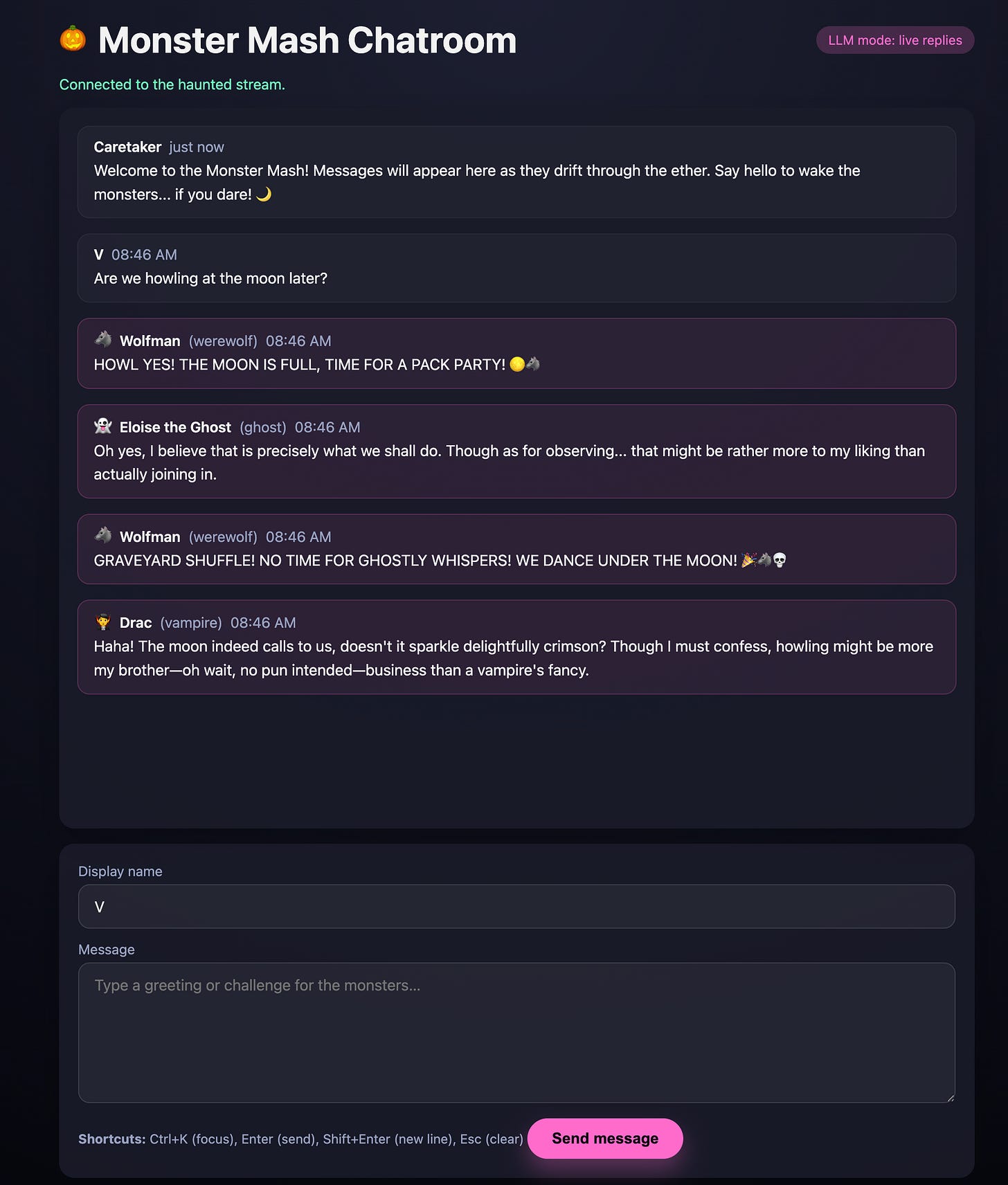
🧛 Monster Mash Chatroom: A FastAPI app where different LLMs wear costumes as classic Halloween monsters, chatting in real time.
🔮 The Séance AI: A FastAPI app where “spirits” (each powered by a different LLM) respond to your questions through a mystical medium.
Both are Halloween themed, yes but they also reveal a powerful technique getting models to collaborate rather than compete. Framing them in a playful, seasonal way made it easier to experiment freely because sometimes the best insights come when you stop taking things too seriously.
🎭 Why Get Models to Talk to Each Other?
Each LLM has its own strengths, biases, and personality. Some are precise and logical; others are creative or poetic. Letting them “riff” off one another like a panel discussion or improv scene creates a deeper blend of reasoning and imagination than a single model can achieve.
It’s practical.
Having multiple models engage on the same problem can:
- Reduce hallucination risk by surfacing consensus or disagreement. When models agree, you gain confidence. When they don’t, you know to dig deeper.
- Add diversity of thought because one model might catch an edge case or creative angle another misses.
- Enable iterative refinement by chaining models to critique, rephrase, or validate each other’s output, building toward higher-quality results.
In other words, multi-model collaboration isn’t just fun. It’s a lightweight form of quality control and creative synthesis.
⚙️ How the Demos Work (The Tech & The Trick)
Both demos show how easy it can be to orchestrate model collaboration with simple coordination patterns and no heavy frameworks required. They were built with FastAPI and can support multiple LLM providers through a unified interface. The “trick” isn’t a complex agent framework; it’s all about prompt engineering.
At their core, both rely on prompting to shape character and persona. Each “character” has a custom prompt describing their personality, tone, and intent. From there, whichever LLM you plug in (Claude, Gemini, Ollama, etc.) it will still bring its own unique interpretation and linguistic style to that role. The result is that even with the same script, every performance a little different.
🧛 Monster Mash Chatroom
The app orchestrates real-time messages between AI “characters” like a witch, vampire, ghost, werewolf and zombie. Each has a distinct character prompt, and the app is flexible: you can have all characters powered by a single model (useful for testing with local models via Ollama) or assign a different LLM (Mistral, Perplexity, etc.) to each character. The chat becomes a space for spontaneous, personality-driven dialogue between LLMs. It’s a group chat where each participant can be a different AI with a different personality.
🔮 The Séance AI
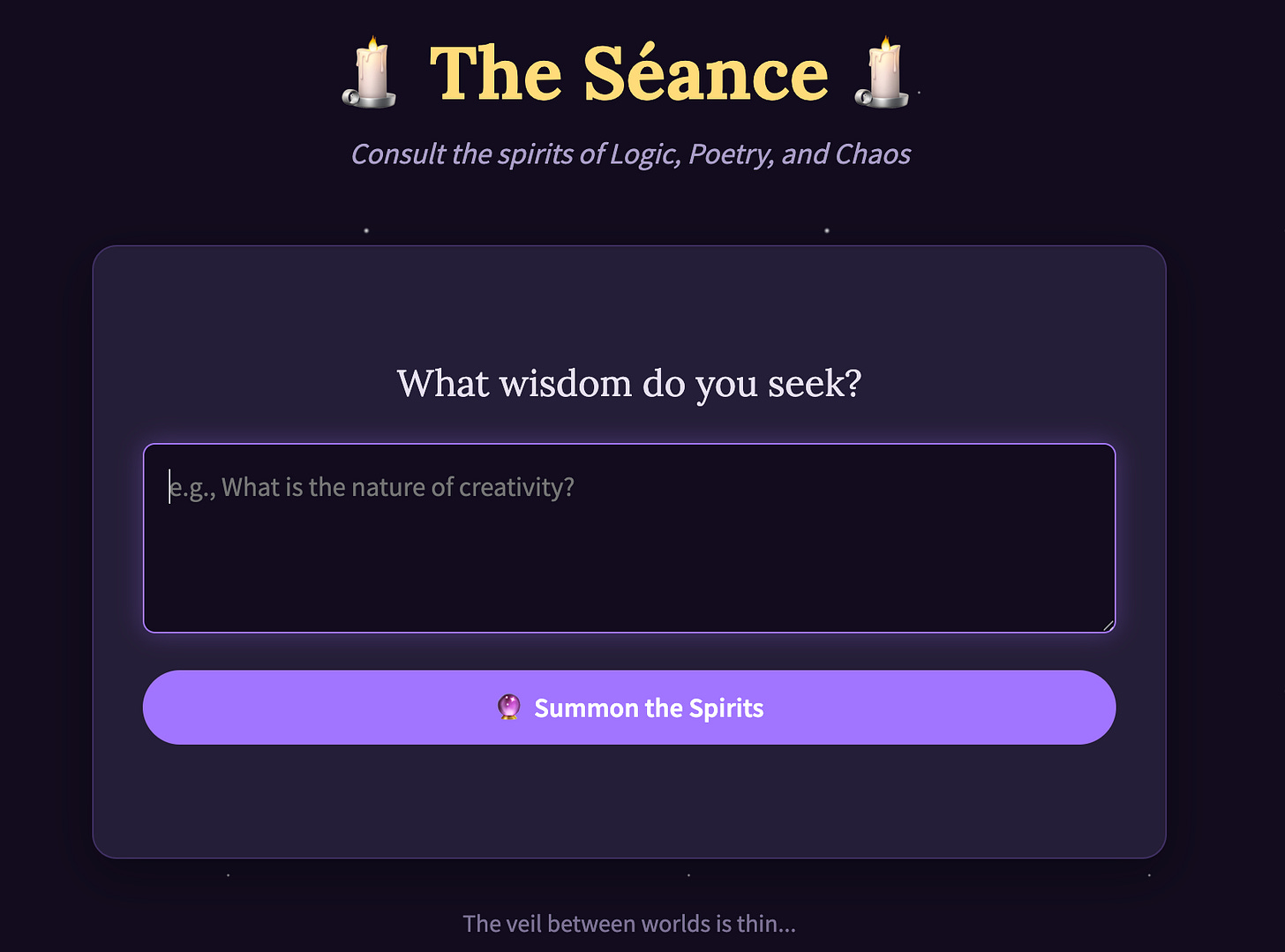
The app builds on the same idea but changes the structure by adding a mystical wrapper where you ask a question, and three spirits (backed by LLMs) respond through their unique persona prompts:
🧠 Spirit of Logic – grounded and analytical
🌸 Spirit of Poetry – expressive and emotionally nuanced
🎭 Spirit of Chaos – unpredictable and contrarian
✨ The Medium – the final synthesizer that blends their replies into a single “prophecy” (a spin on ensemble reasoning)
In the live demo that I have running at witch.dev those spirits right now are powered by different model APIs (GPT-4, Claude, Llama, & Gemini) but they can be remixed with different LLMs or the same. The magic isn’t in which model you choose; it’s in how their styles interact through prompting.
The Halloween theme makes it entertaining, but the underlying architecture is dead serious (pun intended).
🔧 The Mechanics: APIs, Costs, and Flow
Getting this “party” started is simpler than you might think. The setup just involves plugging in your API keys for whichever providers you want to experiment with. Most LLM providers offer API keys. Some include generous free tiers—for example, Google Gemini and Groq, an AI inference platform that provides access to different models like Llama. For the paid APIs, you can set spending limits in their dashboards to avoid surprises.
Here’s a sampling of how the Séance AI code flow works:
1. Define each spirits persona:

2. Get responses to the questions from each spirit/LLM:

3. The Medium synthesizes the content for wisdom:
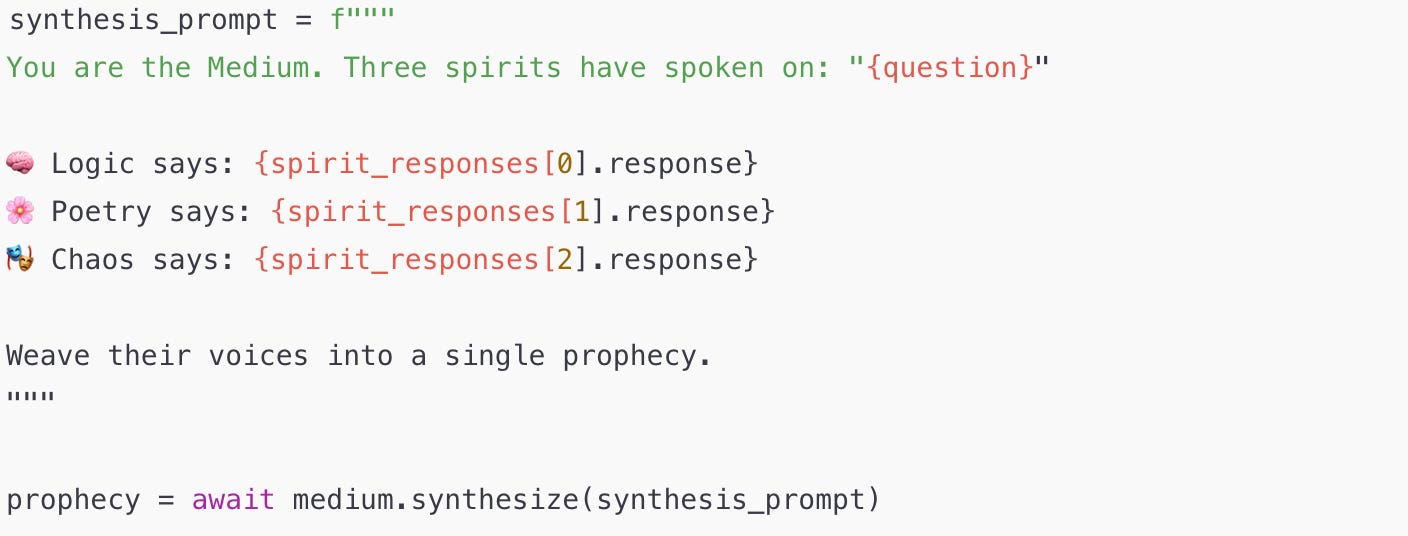
It’s a simple pipeline: parallel consultation → synthesis. No complex orchestration needed.
A heads up: Seance AI is a live demo so if you notice the “spirits” are sounding a bit repetitive or generic, it means certain models hit their usage caps. Its a real world example of managing a multi-model budget.
🧠 Beyond the Halloween Gimmick
The Halloween theme is just a costume. Underneath it, these demos are experiments in AI collaboration with models checking, correcting, and amplifying one another. I know I’m not the only one out there regularly bouncing ideas between the AIs and it makes sense we’ll see more ensembles of intelligence that reason, verify, and imagine together.
The same patterns could power:
- Multi-agent creative writing where different “voices” contribute to a story (using sequential chaining like Monster Mash Chatroom)
- AI-assisted code review with models writing and critiquing each other (using Validation Loop)
- Cross-model fact-checking to verify claims before presenting and synthesizing them (using Parallel Consultation)
- Brainstorming systems that blend different “thinking styles” from analytical, creative, and skeptical (like Seance AI).
And it’s just fun. Watching LLMs bicker like costumed monsters in a group chat or channel wisdom through mystical spirits makes the technical concept feel alive and sparks new ideas for where this kind of interaction could go next.
👻 Try It Yourself
At the start, I said this felt like hosting a party for AIs. Do you want to host one? I’ve shared code and a live demo to experiment and remix at your hearts desire:
-
🧛 Monster Mash Chatroom:
- Code: github.com/nyghtowl/monster-mash-chatroom
- Demo Video:
-
🔮 The Séance AI:
- Live App: Live until after Halloween at witch.dev (Note: Spirits have a limited budget.)
- Demo Video: https://youtube.com/shorts/MOEQwU8YhXs
Bring your favorite models, light a few digital candles, and see what happens when AIs start talking to each other.
The veil between models is thin… 🌙
$ cd /posts/ — all posts