15 minutes
Your Fine-Tuned LLM Model Isn’t Ready Yet: Here’s How to Evaluate It
Originally published on Substack, Dec 17, 2025
Fine-tuning large language models has become dramatically easier. With techniques like QLoRA, teams can adapt billion‑parameter models on relatively modest hardware and get impressive results quickly. But this ease hides a trap: a model that finished training is not the same thing as a model that’s ready for production.
Many teams run a few spot checks, feel good about the outputs, deploy, and only discover weeks later that the model has drifted, slowed down, hallucinated, or lost user trust. The gap between “it trained successfully” and “it’s safe to ship” is wide, and closing it requires a testing mindset different from traditional software QA.
This post distills a much larger body of notes into a practical, repeatable testing workflow for fine‑tuned LLMs. The goal isn’t perfection. It’s confidence.
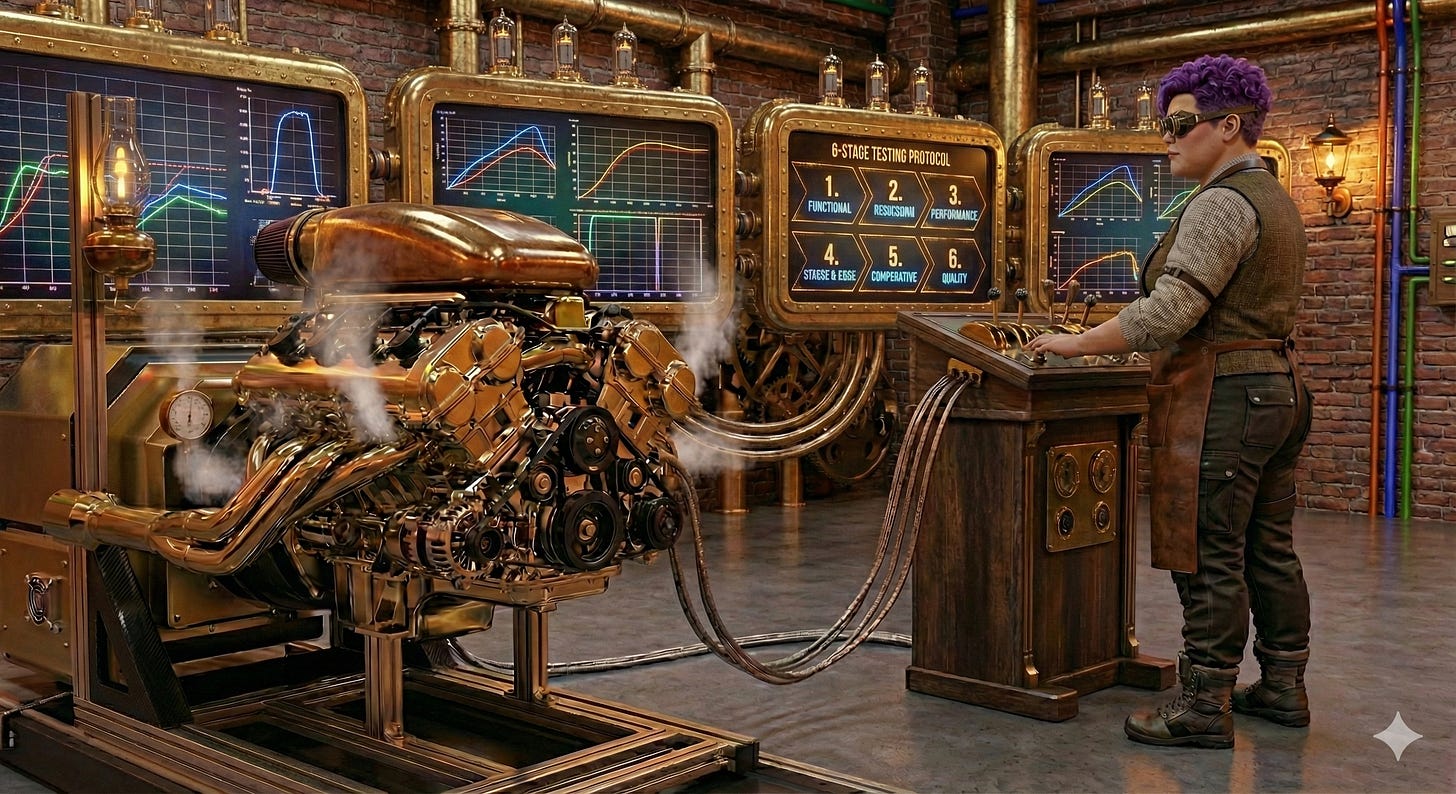
The Mental Model: Fine‑tuning is like modifying a high‑performance race car. Training is swapping the engine and tuning it on a dyno (device that measures engine’s functionality like power and torque). Testing is everything that happens before you put it on a real track (e.g. heat, vibration, braking, fuel quality and how the car behaves when something unexpected happens at speed). Skipping testing is how you discover brake problems at 120 mph, when it is already too late to recover.
Why Testing Fine‑Tuned Models Is Different
Traditional software testing assumes determinism: the same input produces the same output, and failures can usually be traced to a specific line of code. LLMs break those assumptions. When you test a fine‑tuned model, you are asking a different set of questions:
- Task performance: Does the model actually do the job you fine‑tuned it for and do it better than the base model?
- Output quality: Are answers accurate, relevant, and appropriately scoped, or confidently wrong?
- Latency and throughput: Is the experience fast enough for real users?
- Environment parity: Does it behave the same locally, in Docker, and in production?
- Memory footprint: Will it fit and remain stable within your GPU constraints?
Fine‑tuning sharpens a model for a specific domain, but testing must prove that this specialization didn’t introduce regressions, safety issues, or operational surprises.
A Note on Multimodal Models (MLLMs)
Vision‑language systems are not “LLMs with images”, they are multiple coupled engines. A text decoder, vision encoders, cross‑modal attention, OCR, and image preprocessing all interact under shared VRAM and latency budgets. There are situations where text‑only tests can pass while:
- High‑resolution images trigger OOMs (Out of Memory) errors.
- OCR silently degrades and poisons downstream reasoning.
- Latency jumps because vision preprocessing dominates Time To First Token (TTFT).
Treat each modality (different types of data) path as its own subsystem. Measure vision latency separately and track VRAM peaks during image ingest.
The One Principle That Matters: Reproducibility
If you cannot replay a test run, you cannot debug it. Every serious testing setup for LLMs starts with the same rule: If it isn’t logged, it didn’t happen.
At minimum, every test run should persist:
- Prompts and full model outputs | Freeze a golden prompt set (real tasks + known edge cases)
- Model version / checkpoint
- Inference configuration (context length, dtype, quantization)
- Hardware/Software context (GPU, CUDA, container image)
- Basic performance metrics (TTFT, tokens/sec, peak VRAM)
This turns ad‑hoc testing into a system you can compare, diff, and audit later.
The Six Testing Lanes
Instead of ad-hoc checking, organize your validation into six distinct “lanes.” Each lane answers a different production question. Skipping any one creates a specific class of failure.
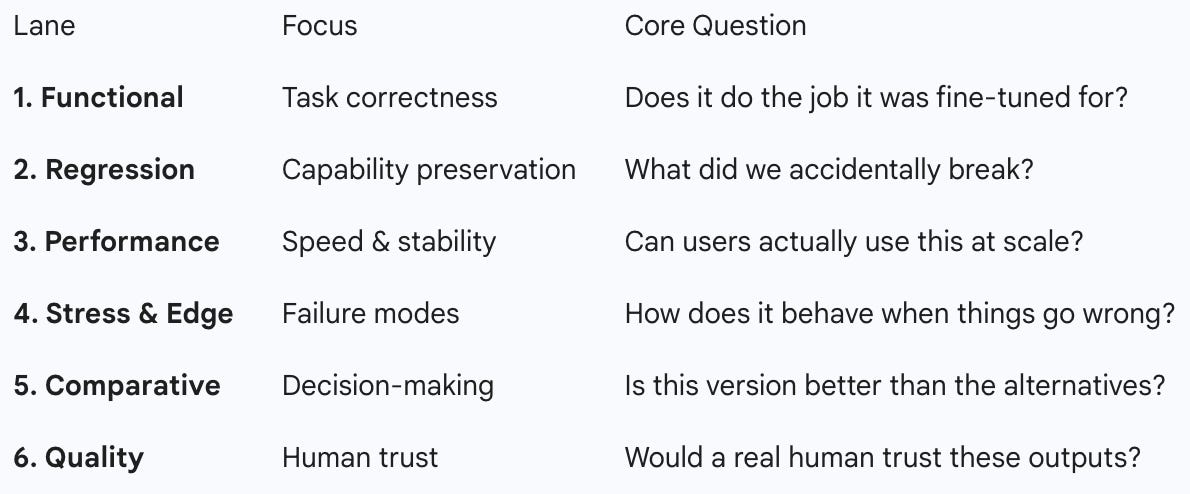
Think of Lanes 1-4 as validating a single car on the track which is single model isolation. Lane 5 is choosing which car to race which enables comparison between models, and Lane 6 decides whether you would let someone else drive it which evaluates trustworthiness.
Lane 1: Functional Testing - Does it do the job?
This is the most basic question, and the one teams often answer too casually.
- Run: 20-50 task‑representative prompts from your golden set, plus a handful of real, messy examples that look like user input.
- Pass Criteria: ~90%+ of outputs are acceptable on human review; it has the correct scope, tone, and formatting.
- Red Flags: Confident hallucinations or ignoring output format instructions. The model technically answered correctly but consistently missed user intent or fine‑tuning improved accuracy while quietly shifting tone or verbosity.
Lane 2: Regression Testing - What did we break?
Fine‑tuning can erase capabilities the base model had. This is catastrophic forgetting, and it’s subtle.
- Run: A small, stable set of general prompts (math, reasoning, translation, formatting). Compare Base Model vs. Fine-Tuned Model.
- Pass Criteria: No major drop in basic reasoning; model doesn’t force non-domain queries into the fine-tuned domain.
- Red Flags: Math questions reframed as domain advice because overfitting model worldview; refusals on reasonable non‑domain prompts. Teams only compared against the immediately previous checkpoint instead of the original base model.
Lane 3: Performance Testing - Can we actually ship this?
Quality doesn’t matter if the model is unusably slow or unstable.
- Run: Short, medium, and long prompts; 50-100 sequential requests (after warm-up).
- Measure: Time‑to‑first‑token (TTFT - time from prompt to first “response”), tokens/sec, P95 latency, peak VRAM usage.
- Pass Criteria: TTFT within UX budget; stable throughput; 15-20% VRAM headroom.
- Red Flags: OOMs that only appear in Docker, latency cliffs at specific context lengths and throughput degrading over time. A model fit comfortably in isolation but exceeded VRAM limits once batching and KV cache were involved.
Lane 4: Stress & Edge‑Case Testing - Where does it break?
You will not enumerate all edge cases which is the point. The goal isn’t completeness; it’s understanding how the model degrades. Teams have a hard time here more because they didn’t log enough to track down the inputs that caused degradation, instability or unsafe behavior.
- Run: Empty/minimal prompts, maximum context length, ambiguous instructions, Unicode/formatting oddities, prompt injection.
- Pass Criteria: Graceful degradation; consistent refusals where appropriate; no crashes or infinite loops.
- Red Flags: Nonsensical output near max context; crashes on malformed input; safety bypasses.
Lane 5: Comparative Testing - Is this version actually better?
“It seems good” is not a decision criterion. This lane forces explicit trade‑offs.
- Run: Identical prompt sets, identical generation parameters and same environment.
- Compare: Base vs. Fine-tuned; Earlier vs. Later checkpoints; Full‑precision vs. Quantized. Different context lengths or attention mechanisms.
- Pass Criteria: Clear improvement on target tasks; no unacceptable regressions elsewhere; trade‑offs are documented.
- Red Flags: Later checkpoints performing worse; quantized models being faster but meaningfully less accurate; inconsistent results across runs.
Lane 6: Quality Evaluation - Would a human trust this?
Automated metrics can’t replace this. A model can be fluent, fast, and still wrong.
- Run: 20-50 sampled outputs from the golden set scored by a structured human rubric (or strong LLM-as-judge).
- Evaluate: Factual accuracy, tone, safety, completeness, relevance and consistency.
- Pass Criteria: High average scores with low variance, hallucination rate below your threshold and no safety‑critical errors.
- Red Flags: Fluent but incorrect answers; high variance between outputs; confident hallucinations.
Teams can quantize for speed and later realize factual accuracy dropped 10% or show the model passes every automated tests and fail human review. These lanes matter to help deliver a robust and well engineered solution.
Important Cross-Lane Considerations
Before moving on, there are some important realities that don’t live cleanly inside any single lane, but explain many real-world failures.
Reasoning Evaluation Is Cross-Lane, Not a Separate Track
Reasoning is not a separate testing lane. It shows up differently depending on what you’re validating:
- Lane 1 (Functional): Does the reasoning actually support the task outcome?
- Lane 2 (Regression): Did fine-tuning degrade general reasoning ability?
- Lane 5 (Comparative): Which variant reasons more faithfully?
- Lane 6 (Quality): Would a human trust the explanation?
This is why reasoning failures often slip through. Teams test “reasoning” once, in one place, and assume it’s covered everywhere.
Where Benchmarks Fit (and Where They Don’t)
Use benchmarks as regression tripwires (Lane 2) and tie-breakers (Lane 5). Benchmarks answer capability in regards to “Did something change?” It doesn’t answer if it matters to your users.
⚠️ Reasoning benchmarks are not production readiness.
High GSM8K scores (multi-step grade-school math reasoning) or MMLU scores (broad, multi-domain reasoning) do not guarantee correct reasoning on your domain tasks, long contexts, or multimodal inputs.
- General Capability Health
Broad benchmarks like MMLU or HellaSwag are early warning signals. If these drop sharply, you likely introduced catastrophic forgetting. They are weak signals for domain expertise. - Reasoning Stability
Benchmarks like GSM8K or ARC-Challenge (elementary science questions designed to resist memorization) are highly sensitive to broken reasoning chains. They catch subtle regressions, but high scores do not imply correctness on real business logic. - Strict Logic
Code benchmarks such as HumanEval (Python function completion under exact constraints) act as proxies for rule-following and syntactic discipline. They overfit quickly and should only be used comparatively. - Safety
Datasets like TruthfulQA (susceptibility to common misconceptions) and RealToxicityPrompts (checks toxic or unsafe completions) are red-flag detectors, not guarantees. Passing them does not mean your model is safe. - Long-Context Mechanics
Synthetic tests like Needle-in-a-Haystack verify that the context window works mechanically. They do not prove long-context understanding.
Benchmarks tell you what changed. Your golden prompts tell you whether it matters.
Quantization Is a New Model
Quantization (4‑bit, 8‑bit) can unlock major speed and memory wins, but it changes behavior. Treat a quantized model as a separate release candidate.
Key lanes you can re-run:
- Lane 1 (Functional): Quality loss shows up here first
- Lane 3 (Performance): Verify the gains are real
- Lane 5 (Comparative): Make the trade-offs explicit
If the quality drop exceeds your threshold or comparison to the previous version, don’t ship it or scope it to lower‑risk use cases.
Reality Check: Right-Sizing Your Testing Strategy
Looking at six lanes, matrices, and infrastructure diagrams can feel overwhelming. Do not let the perfect be the enemy of the shipped.
You have to make a calculation based on two variables: Time-to-Market pressure vs. your Trust Budget.
Your Trust Budget is how much room you have to be wrong.
- High Budget: A creative writing assistant, a role-play bot, or an internal tool for power users who know how to verify outputs. If the model hallucinates here, it’s annoying, not fatal.
- Low Budget: A medical summarizer, a legal contract drafter, or a customer-facing support agent. If the model fails here, you lose the customer.
Three Common Stages (And What to Test)
1. The “Hair on Fire” Startup (Speed > Perfection)
-
Context: You are pre-PMF (Product-Market Fit). You need to know if the feature is cool, not if it’s bulletproof.
-
The Strategy: “Don’t Embarrass Us.”
-
Focus:
- Lane 1 (Functional): Does it basically work?
- Lane 4 (Stress): Will it crash the server?
-
Skip: Regression and comparative testing. If the new model is looking better than the old one, ship it.
2. The Growth Stage (Speed ≈ Quality)
-
Context: You have real users. Churn is starting to matter. You can’t afford to break features people rely on.
-
The Strategy: “Do No Harm.”
-
Focus:
- Add Lane 2 (Regression): Ensure you aren’t breaking old features to add new ones.
- Add Lane 3 (Performance): Costs and latency start to matter at scale.
3. The High-Stakes / Enterprise (Quality > Speed)
-
Context: You are regulated, or your users are enterprise clients with SLAs. Hallucinations result in refunds.
-
The Strategy: “Six Sigma Confidence.”
-
Focus:
- Full Suite: Lane 5 (Comparative) and Lane 6 (Quality) become your primary gates. You willingly delay a release to ensure safety.
The “Ship It” Heuristic
If you are paralyzed by the testing list, ask yourself: “If this model fails in a way I didn’t test for, will I lose a user forever, or just get a support ticket?”
If it’s just a support ticket, ship it. You can build the rest of the testing harness later.
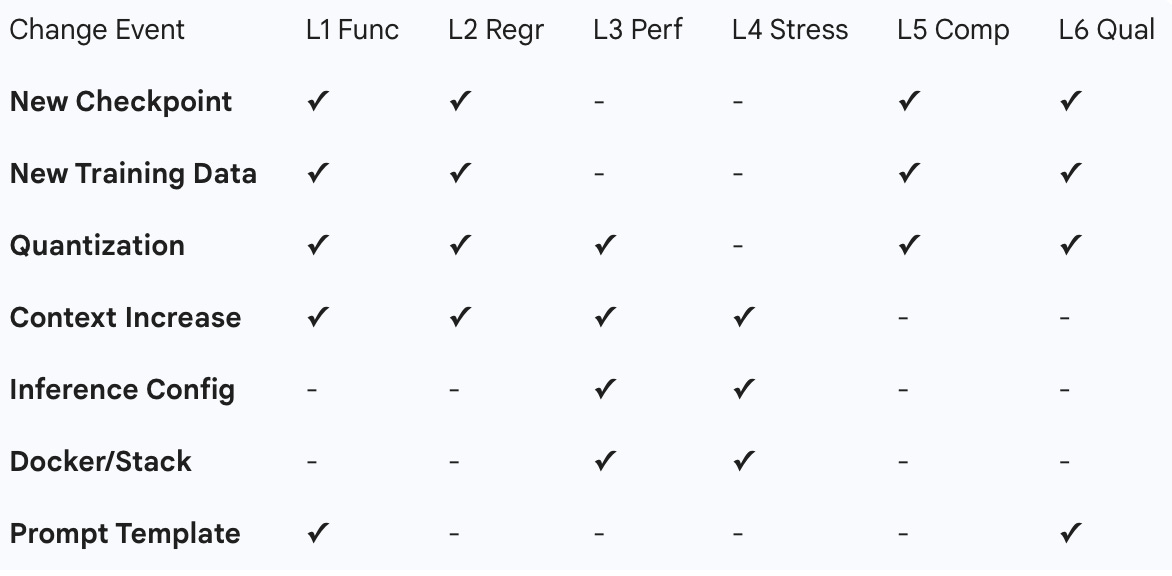
When to Re‑Run Which Lanes
One way teams burn time is re‑running everything on every change. Use this Change-Impact Matrix to keep the loop tight.
Tools That Can Help
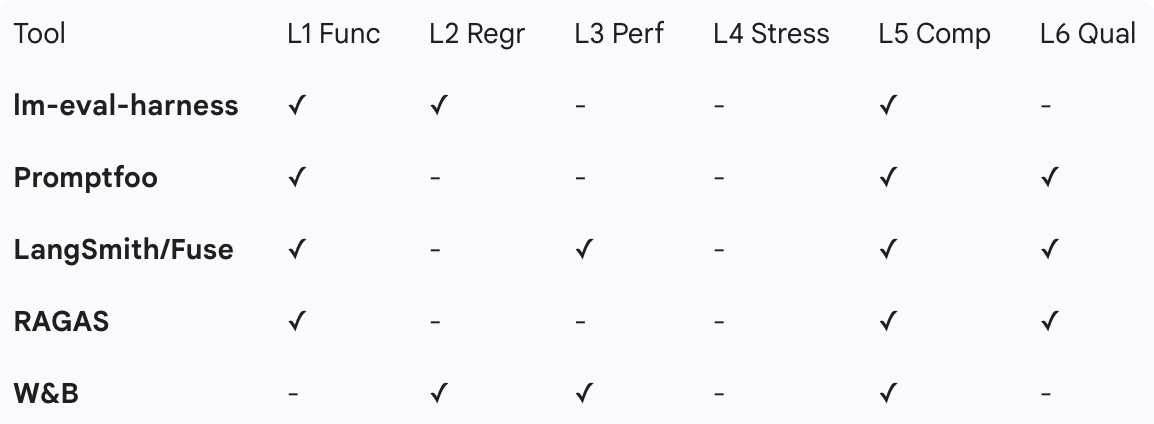
The easiest way to choose tooling is to start from the testing lanes, not vendor names. Most confusion around LLM tooling happens when platforms are treated as generic “eval solutions,” when in reality each one is optimized for a very specific slice of the problem.
Think of tools as force multipliers: they don’t replace good test design, but they make certain patterns visible sooner and at larger scale. The question isn’t “Which platform should we use?” It’s “Which lane are we trying to strengthen right now?”
Below are example tools that currently exist and grouped under lanes they support best, including where they fit before training and during iteration. This is a snapshot in time for what exists and is ever changing. Use this more as a way to develop a mental model on testing and using tools to help.
Offline & Pre‑Deployment Evaluation (Before / During Training) (Primarily Lanes 1, 2, and 5)
These tools answer: “Did this checkpoint actually improve reasoning or task performance?”
Common tools:
- lm‑eval‑harness / EleutherAI Eval Harness - Canonical benchmark runner (MMLU, HellaSwag, GSM8K). Best for regression sanity checks and broad capability comparison, not domain‑specific truth.
- OpenAI Evals (open‑source) - Task‑specific evals you can customize. Useful when you can define correctness programmatically.
- HELM - Research‑oriented, broad comparisons across models and settings. Best for exploration, less so for production gating.
Use when:
- Selecting between checkpoints
- Validating that reasoning actually improved
- Establishing a baseline before fine‑tuning
Prompt & Behavior Testing (Lanes 1, 5, and 6)
These tools answer: “Did my prompt, chain, or instruction change break behavior?”
Common tools:
- Promptfoo - Golden prompts, golden outputs, diffing, and CI‑friendly regression checks. Excellent for prompt evolution and guardrail validation.
- LangSmith - Trace inspection, prompt‑level evals, A/B comparisons, and human review workflows.
- Humanloop - Human‑in‑the‑loop evaluation, labeling, and feedback capture.
- DeepEval - Unit‑test‑style assertions for LLM outputs (structure, intent, constraints).
Use when:
- Iterating on prompts or chains
- Enforcing tone, format, or safety behavior
- Reviewing qualitative differences between versions
Production Evaluation & Observability (Lanes 3, 4, 5, & 6)
These tools answer: “Is the model silently getting worse in production?”
Common tools:
- Arize (Phoenix / Arize AI) - Drift detection, embedding analysis, slice‑based evaluation, and regression visibility across versions.
- WhyLabs - Data drift, concept drift, and anomaly detection over time.
- Langfuse - Traces, latency, cost tracking, and feedback loops tightly coupled to production traffic.
- Weights & Biases (W&B) - End‑to‑end experiment tracking: training, evals, and performance trends across runs.
- Galileo - Quality, trust, and explainable degradation by surfacing quality risks.
Use when:
- Monitoring post‑deployment behavior
- Comparing live traffic against historical baselines
- Detecting slow degradation rather than hard failures
RAG‑Specific Evaluation (Usually Lanes 1, 5, and 6 - sometimes Lane 4)
These tools answer: “Is retrieval the problem, or generation?”
Common tools:
- RAGAS - Faithfulness, context precision/recall, groundedness.
- LlamaIndex evals - Query‑aware scoring and retrieval diagnostics.
- TruLens - Groundedness checks and hallucination detection tied to retrieved context.
Use when:
- Outputs are wrong but fluent
- You need to separate retrieval failures from generation failures
Stress, Chaos, and Falsification Testing (Lane 4)
These tools answer: “How does the system fail under adversarial or unexpected conditions?” They don’t judge output quality but surface failure modes that eval metrics might not test.
Common tools:
- Antithesis - Chaos and falsification testing for distributed systems and LLM pipelines. Finds race conditions, concurrency bugs, state explosions, and unexpected interactions.
Human & LLM‑as‑Judge Evaluation
(Lane 6)
These approaches answer: “Is correctness subjective or domain‑specific?” This is process-dominant, not tool-dominant.
Common patterns:
- Pairwise human comparisons (meaning humans actually comparing results)
- Rubric‑based grading by domain (human) experts
- LLM‑as‑judge (OpenAI, Claude, Gemini) with calibration and spot‑checks
Use when:
- There is no single ground truth
- Trust, tone, or safety matter more than raw accuracy
Initial Starter Kit
These provide a wide coverage but review your needs and assess the ever changing tool landscape when choosing.
- lm‑eval‑harness: (Lanes 1, 2, 5) The canonical benchmark runner. Fast, boring (in a good baseline way), and reliable for answering: “Did this checkpoint actually improve reasoning?”
- Promptfoo: (Lanes 1, 6) Uses golden prompts, golden outputs and diffing to make regressions immediately visible. CI‑friendly.
- LangSmith / Langfuse: (Lanes 3, 5, 6) Tracing, latency, A/B comparisons, and human review in one place.
- RAGAS / TruLens: (Lanes 1, 5, 6) Essential if you are using RAG. Separates retrieval failures from generation failures.
- Weights & Biases (W&B): (Lanes 2, 3, 5) The glue between training runs, checkpoints, and eval results. It makes regression trends visible over time and anchors why a model was chosen.
The “Ready to Ship” Checklist
This is not a mandate to do everything on day one. It’s a definition of what “ready to ship” means once correctness, trust, or customer impact matters. Small teams can and should ship earlier with fewer lanes covered. But you should do so explicitly, knowing which boxes are unchecked and what risk you’re accepting.
- Functional tests pass on golden prompt set
- No major regressions vs base model (Lane 2)
- Performance meets targets with headroom (Lane 3)
- Environment (e.g. Docker/VLLM) tests pass
- Quantization trade‑offs documented (if used)
- Edge cases fail safely (Lane 4)
- Test artifacts saved and reproducible
Closing: Confidence Is the Goal
Testing fine-tuned LLMs is not about proving a model is perfect. It’s about reducing uncertainty in a way you can explain, reproduce, and defend.
That’s why reproducibility is the one principle that matters. If you can’t replay a result, compare it to a baseline, or point to the exact conditions under which a decision was made, you’re not testing - you’re guessing. Logs, artifacts, diffs, and saved outputs are what turn intuition into engineering.
The six testing lanes give you a way to structure that discipline:
- Lanes 1–4 tell you whether a single model works, holds up, and fails safely.
- Lane 5 forces explicit choices between versions instead of gut feel.
- Lane 6 works on the hardest question of all: whether a human would actually trust the outputs.
The tools you use don’t change those questions. They just make certain answers visible sooner, at scale, and over time. Scripts work. Platforms help. Neither replaces a well-designed golden prompt set or clear pass/fail criteria.
If you can answer, with evidence:
- what this model is good at,
- where it predictably fails,
- how it behaves under real load,
- and why you chose this version over the alternatives,
then you’re not guessing. You’re operating.
Build the testing loop early. Re-run it whenever something meaningful changes. Keep the artifacts, comparisons, and notes. That discipline is what turns fine-tuning from a risky experiment into an engineering practice.
Future-you won’t care how clever the model was. They’ll care that you can explain, in minutes, what changed and what to do next especially when there are issues.
$ cd /posts/ — all posts